Most SEO companies will send you a report, if they send you anything at all. Here’s your keyword. Here’s your position. Boom, look how well we’re doing.
That may have worked a few years ago. It doesn’t work now, and the reason is sitting in your pocket.
Everybody searches from a phone. People search from the train, from a parking lot, from somebody else’s kitchen. The desktops that are left are scattered in houses all over the area. So when a report tells you that you rank third, the only honest question is: third from where?
Usually the answer is that it was measured from your own address. Which is the one place on earth you were always going to look good.
What a geo grid actually does
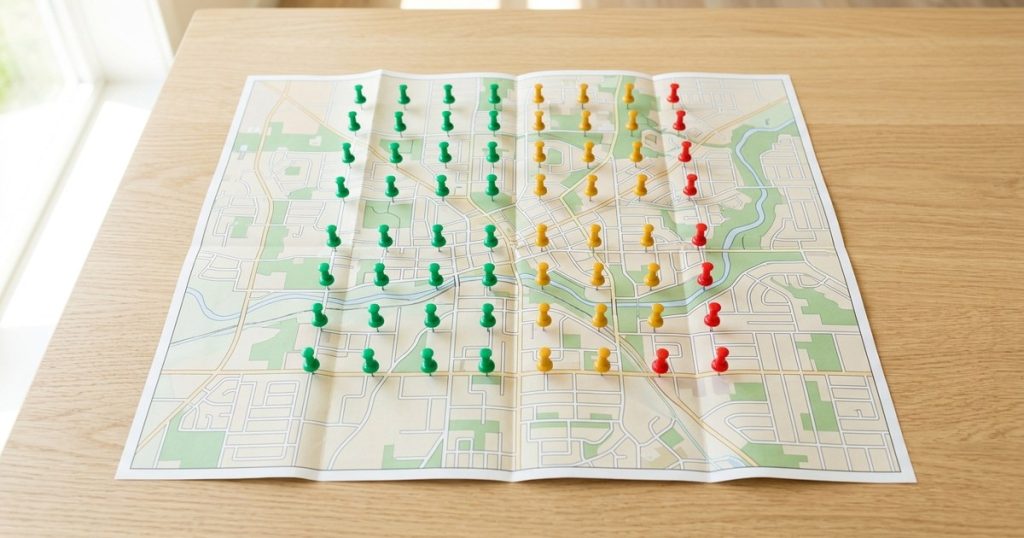
You take your service area and you break it into coverage points. A grid.
At each point, it’s as if somebody is standing right there, at that little balloon on the map, running the search. Then they walk down the street to the next point and run it again. And the next one. And the next one.
You end up with dozens of real answers instead of one, and they will not all agree. That’s not a flaw in the measurement. That’s what your customers are actually experiencing, and it’s the first time most business owners get to see it.
As far as I’m concerned this is the only way to know how you’re really ranking today.
Two different answers on the same page
Here’s where the good systems earn their keep. The system we use doesn’t just report a position. It separates two things that most reports mash together.
Local pack. The map results. The three businesses shown with the little map above them.
Organic. The traditional blue links underneath.
Both tell part of the story, and they can be wildly different at the same grid point. You might be sitting pretty in the organic results and nowhere at all in the map, which in practice means the phone isn’t ringing. A single blended number hides that completely.
Local pack is where local businesses need to be. That’s not a preference, that’s just where the calls come from.
What the page actually looks like now
Think about the last search you ran on your phone.
At the top, an AI answer. Below that, the local pack. Then, a distant third, the organic listings, and a good many of those are aggregators and directories rather than actual businesses.
Which means real organic results for a local business are getting pushed down to the bottom of page one, and often onto page two. Some people scroll that far. Most don’t.
So the best grid systems now report on that first block too, the AI answers, because that’s the part of the page people see first and it’s the part almost nobody is measuring.
Monthly snapshots are where it gets useful
One grid is a photograph. Run it every month and you have something a whole lot better.
You can see whether you’re moving. Not whether a number went up, but whether the map is actually greener than it was thirty days ago, and where.
And here’s the part I care about most: it tells you where to put the work next.
Green bubbles are flattering. They’re not the point.
Let me give you a real example.
One of the businesses I’m involved with ranks at the top across the whole Chicagoland area. Almost the whole grid is green. It’s a lovely thing to look at.
But there are three or four pockets right along the shoreline, north of downtown Chicago, where we’re not in the top three.
That’s the useful information. Not the green. The four spots that aren’t.
Now we know exactly where the effort goes next month. Without the grid, we’d be looking at a report saying we rank first, feeling good about ourselves, and leaving those neighborhoods on the table indefinitely. You cannot fix a weak spot you can’t see.
It’s visual, and that matters more than people admit
You don’t have to read a spreadsheet. You don’t have to squint at rows of numbers trying to figure out what changed.
You look at a map. Green here, orange there, red in that corner. You know in about two seconds where you’re strong and where you have work to do.
For a business owner with about four minutes to think about marketing this week, that’s worth its weight in gold.
What I think every company in this business should be doing
Two things, and I’ll say them plainly.
Every SEO and AEO company should be giving clients this kind of reporting. Not a keyword position. A map of the territory the client actually serves, updated monthly, broken out by local pack and organic and AI.
And every one of them should be running it before they take a client on. Before you quote somebody, before you promise anything, you should know what the map looks like. That’s how you find out what you’re really walking into and what it’s going to take.
I run one before I take on any local client. It takes very little time and it tells me more than an hour of conversation would.
If somebody wants to handle your search visibility and they’ve never looked at your territory this way, ask them why not.
If you’re a Chicagoland business and you’d like to see your own grid, we’ll run one and send it back. No call required. One per business, one search phrase, and we run them by hand, so give us a couple of days.

wpx_srbsoc28
Owner of Strategic Online Corp. Warrenville, Illinois — Chicagoland service area.